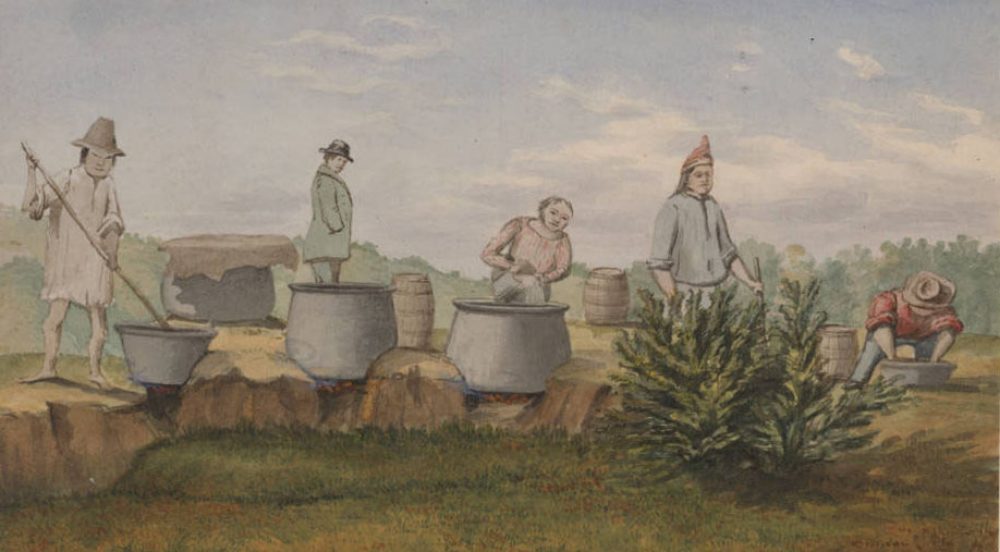
- The cattle were longhorns.
Not true. The “Texas longhorn” developed in Texas and Oklahoma. California breeding stock came from the Portola and de Anza expeditions, and these cattle came from Baja, Sonora, and Tubac, near Tucson. The horns of these Spanish cattle would have been short. But, they would not have been “Shorthorns,” which is a term for a breed of European cattle. (Reference: Rouse, John E., Criollo: Spanish Cattle in the Americas, University of Oklahoma Press, 1977.
- The cattle weighed 1500 pounds.
Not true. The Criollo cattle raised in Alta California were smaller than contemporary beef cattle, like the Hereford. Herefords were bred with Criollo cattle after 1850. A few “Native American” cattle, those used for ox carts and milk, were brought to Texas by Americans, but they interbred only slightly with the feral Criollo cattle before 1850.
Criollo cattle are 600 to 800 pounds, confirmed by Abel Stearns, a Californio ranchero with large herds in Southern California. (Reference: Webb, Edith Buckland, Indian Life at the old missions, University of Nebraska Press. P. 174.
- There was no milk and cheese in Alta California.
Not true. Criollo cattle are good animals for all purposes: traction (pulling carts); milk, and beef. Keeping dairy cattle was not regarded as a necessity, but many did so.
“I have frequently drank my tea or coffee, without milk, on a ranch containing from 3600 to 8000 head of cattle. But in the spring of the year, when the grass was green, the wives of the rancheros made from the milk asaderas, a fresh cheese, in small flat cakes, which had to be eaten the day it was made. (William Heath Davis. Sixty years in California (Kindle Locations 693-698).
- The Californios herded cattle the same way as they do in Texas.
Not true. Although the Texas cattle industry used many Spanish/Mexican practices and equipment, and still does, it developed under very different circumstances. It began after the Civil War; was primarily the practice of rounding up feral cattle, and driving them to Kansas city and the railroad, for transfer to Chicago slaughterhouses. Their primary product was beef.
- The cattle were red-brown with white faces.
Not true. Spanish criollo cattle come in a variety of colors. Herefords are the red-brown breed which everyone thinks of, and these were not present in Alta California. See photos of criollo at:
https://en.wikipedia.org/wiki/Criollo_cattle
- Hides and tallow were shipped to Boston to make shoes.
Not all true. Tallow was shipped on “tallow boats” to South America, especially Callao, Peru, to make soap and candles and feed miners. It was not shipped around the Horn because it was not valuable enough cargo. Hides were, and many found their way onto steam engines, where two-sided leather belts were used as “flat belt drives” to transfer power. It is also true that Boston had 40% of American shoe production until WWI. (https://dp.la/exhibitions/exhibits/show/shoe-industry-massachusetts)
- The “Santa Barbara” spade bit was cruel and hurt the horse’s mouth.
Not true. Watch Daniel Dauphin’s 3 videos titled “A Bit about Bits,” covering everything you need to know. Dauphin Horsemanship, youtube.com
- The spurs worn by vaqueros hurt the horse.
Not true. Watch Daniel Dauphin’s video titled “A Bit about Spurs.”
Dauphin Horsemanship, youtube.com
- All horses and mules were shod.
Not true. The Californios did not shoe their horses. Shoes are a necessity for horses being ridden or driven on cobblestones, hard packed streets, and stony ground. (Re: John Grafton, personal correspondence)
- Vaqueros were white Spanish people.
Not true. Although rancheros (ranch owners) regarded themselves as white Spanish people, they were mostly mixed race. Rancheros were proud to have all the vaquero skills and display them, but the great numbers of vaqueros needed to tend herds on the missions and ranchos were Indians. (This topic is always under discussion.)*
- Vaqueros had very little work to do.
Not true. July to October was the matanza, or killing season, when cattle had to be selected for slaughter and brought in to the matanza ground, kept in order until killed, and skinned. March through May was branding and castrating season, with cattle being brought in to process, several hundred at a time, until all the new calves were marked. In the fall after the matanza, young horses were chosen to break to the saddle, which took six weeks to two months. Much later, in the late 1800s to early 20th century, vaqueros in the lower San Joaquin valley were dismissed for January and February. In Spanish/Mexican California, it is more likely they would have spent this time honing their skills, making reatas from rawhide, repairing saddles, and riding out to doctor cattle. (BW note: timing of the matanza does not agree among references. However, the number of months it takes does agree.)
- Doing vaquero work was an easy job, anyone could do it; soldiers doubled as vaqueros.
Not true. Vaqueros had the skills to become soldiers, but not the other way around. Understanding cattle and horse behavior; driving, training, and taming cattle; roping at great distances, such as 80 feet, and up close; killing an animal humanely; skinning them; taming and saddling horses; training horses to hold a rope taut; all these make the vaquero a highly skilled professional. (Whether soldiers could do vaquero work is not questioned by some. If you watch “Texas Ranch House,” none of the cowboys mastered the reata, the most valuable vaquero tool. Yet these men could probably be taught to shoot in the time given.)
- Vaqueros slept in barracks or bunk houses and had a chuck wagon out on the range.
Not true. The ranchero and his wife had a bed, but that was it. Everyone else slept on the floor, and men slept on the porch or outside. Barracks were not used until after the Civil war, and the invention of chuck wagons is attributed to a Texas rancher in 1886. Vaqueros slept on the ground and ate food they brought with them if they were far from the ranch house. (David Rickman, personal correspondence)
- There were no social classes in Alta California.
Not true. Vaqueros had a high social status, which was displayed by their fine clothing. However, as Indians, they were not regarded as “gente de razon,” as the Spanish/Mexican people were. (Rickman, David, CMF conference presentation, 2016.) (The matter of class and status in Alta California is always under discussion.)
- Americans who visited said the Spanish were lazy, unproductive, and did not take advantage of the resources of the county.
The Spanish/Mexican people were status-conscious, and they regarded many jobs as low class and would not perform them. Owning a shop and selling goods came in that category, so many Yankees settled in to run lucrative supply businesses. Owning land, working cattle, and raising food in kitchen gardens were all passable high status activities. Rancheros and the missions sold beef and produce to the Russians and to ships that called. Until 1821, they could not legally sell anything else to foreigners. Without a local supply or easy importation of raw materials, most manufacturing could not be performed even if they wished to. They did manufacture trade goods out of those raw materials they had available: cattle. (The reasons why there were so few Californio traders remains under discussion.)
- The rancheros were not wealthy.
Not true. It is true that there was very little cash in Alta California. But a land grant of from 48,000 acres to 167,000 acres, to name just the first two on the wikipedia list, are more than ten times the size of what was regarded as a large landholding in England. My favorite example of wealth is a description from William Heath Davis of the horses used for the Peralta-Martinez wedding:
“ In November, 1838, having been invited to a wedding, together with Captain Hinckley I crossed the bay in the schooner ” Isabel,” and arrived just before sunset of a clear November afternoon, at the embarcadero on San Antonio creek, (East Oakland.) Reaching the landing, we were met by a younger brother of the bridegroom, mounted on a splendid black horse, both horse and rider being attired in the richest manner and presenting a very attractive sight.
At the same time there appeared upon the brow of the hill, perhaps twenty yards away, a full caponera of palominos, or cream-colored horses, for the wedding cavalcade. They raised their heads, pausing a moment, startled it seemed at sight of the vessel, and as the bright sun struck full upon them, their colored bodies, of light golden hue, and dazzling manes, shone resplendent. The picture has ever since remained in my mind. They were attended by vaqueros, who cast their lassos and secured two of them for Captain Hinckley and myself, we having brought our saddles with us, a necessity in those days, though you were a guest. The bridegroom had two caponeras for the use of the bridal party; one of canelos, or red roan horses, and the other of twenty-five black horses.” (William Heath Davis. Sixty years in California (Kindle Locations 4506-4519). Kindle Edition.
To explain: a caponera is a group of usually 25 riding horses, all stallions and geldings, as Californios did not ride mares. Davis says that a rancho of 8,000 head would have had 12 caponeras. What is so lovely is that the Peraltas had caponeras of matched colors. Colors in horses are a genetic nightmare to understand, but it remains true that both palominos and roans are among the more rare colors. Having 25 in a group is stunning. (The concept that if there is no market, and/or no ability to sell land , crops, and livestock, then the article has no value, is a modern concept. Entailed land in England, which could not be sold, still accounted for a family’s wealth.)
*When I write that a topic is under discussion, it means that John Grafton and I have differences of opinion. If we do, others will, too.
 Alta California Cattle