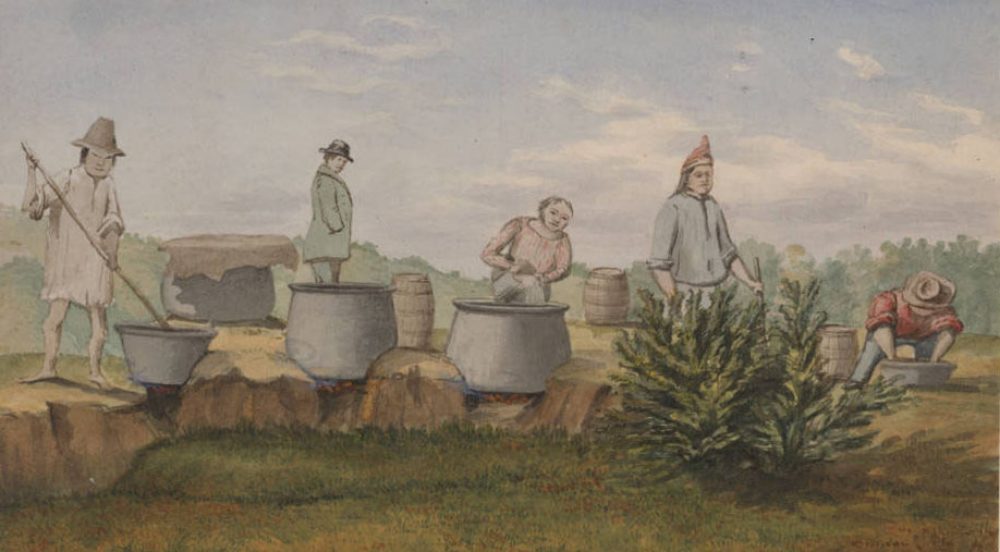
One afternoon when at Sutter’s Fort I pointed out to a visitor some of the uses of rawhide. She said, “oh, like dog chews.” Dog chews are indeed one of the only contemporary uses for rawhide. But in the mission era, it was so important, that it is listed on Santa Barbara presidio orders to Mexico city for supplies.
I am writing this still feeling the excitement of visiting the Santa Cruz Mission and taking a gander at the roof of the only original building, the neophyte housing. Here is what I saw:
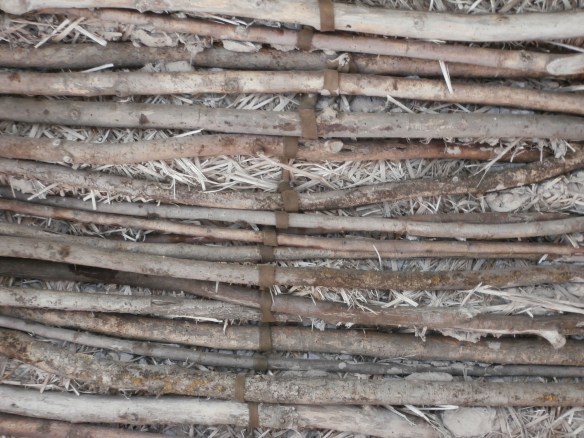
This was the first thing that caught my attention. This rawhide weaving looks like a dark brown stripe down the middle of the roof understructure, in between the beams. This close up shows how it was done. The technique was also commonly used for making ramada roofs. I have not yet found a description of a ramada from the time period, but many assume they were simple structures, four poles holding up a roof. In the Gold Rush era, even a stack of branches with a piece of cloth over it could be called a ramada.
The long sticks are laid out on the ground, and two long pieces of rawhide are tied to each other and to the first stick, in its center. One rawhide strip wraps around each side of the first stick, then cross over each other, and another stick is added, and the strips crossed over them again. I do not know if this weaving was done in place, on the roof structure, or on the ground and then tied in. I am guessing they did it on the ground and then installed it with the vegetation that you also see here.
Rawhide is worked wet, so when it dries, it shrinks. These sticks are still held firmly.
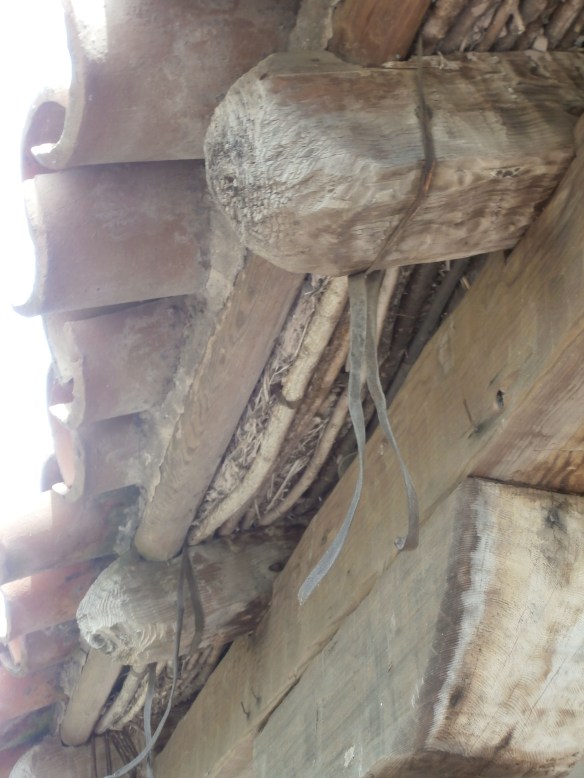
The next step was to tie these “mats” of woven sticks to the beams.

Here you can see they “sewed” the woven willow mats onto the beams.
They tidily knotted it off and the tail ends can still be seen sticking out.
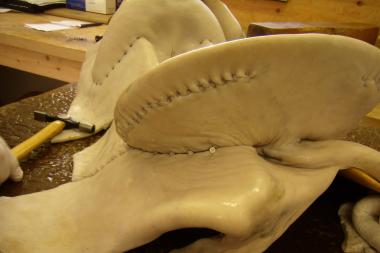
Other important uses for rawhide were:
Holding together saddle trees: picture thanks to Rod Nickel Saddle Trees:
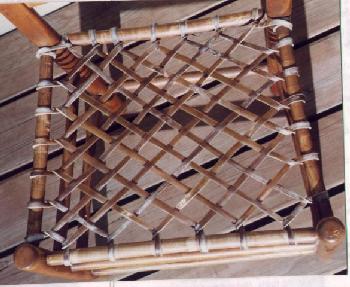
For chair bottoms: picture thanks to Randy S. Keeling:
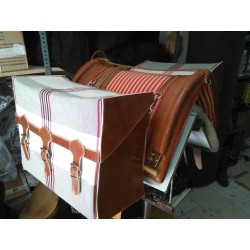
In a tiny hamlet near a mission in Baja a man had created his own museum. I apologize for breaking my camera before I got there, but here was a wonderful use of rawhide, a pair of alforjas, or saddle bags. But really, they were more like pack saddle boxes. Each looked like it had been cut from one hide; the hair was left on, on the outside; the box itself measured at least 15 X 15 X 20, that is, bigger and boxier than a carry-on piece of luggage, and like some Rubbermaid storage containers. It had a cover with a flap over the side. They were big! And stiff, unlike many other pack saddle bags, which are of canvas and soft. I could have packed a complete set of fine china in them, and gotten them up Baja trails with no breakage. The closest example I have found on the net is below: but it’s much smaller, and much too well made to compare.
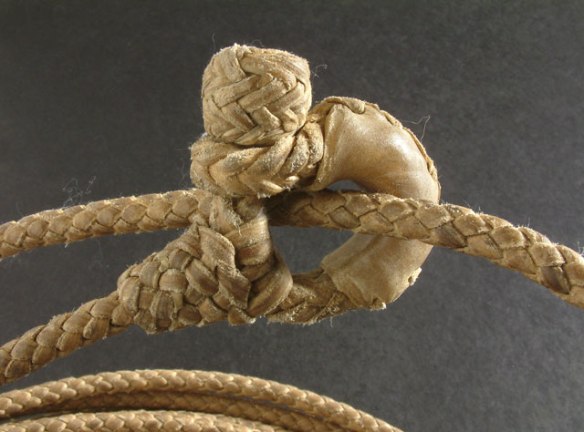
Luis Ortega is renowned for his cuero crudo work. Here is a close up of the honda on a reata he braided (thanks to the Autry)
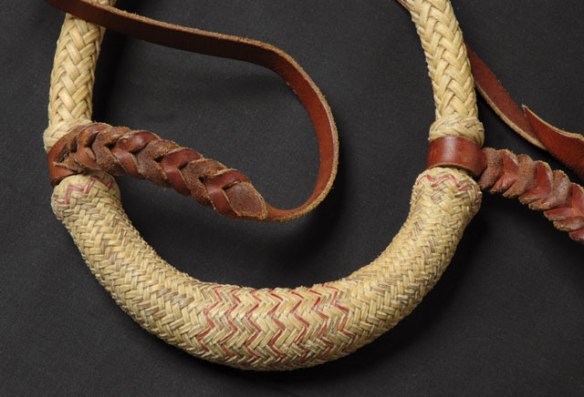
Here is a close-up of the top of a jaquima or hackamore, (thanks to the Autry):
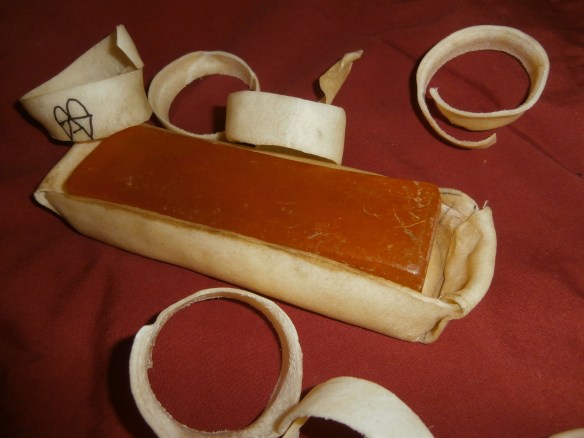
Last are a couple things I did with rawhide remnants, bought on ebay from White Bear Leather: a half pound gives you plenty to mess with. These are bracelets I made by wrapping strips around cans of the right size, taping them on, and letting them dry. My brand is on one. The other is a holder I made for the bar of glycerin saddle soap. I also punched out some buttons which did go through the wash but turned oval instead of round. Have fun!
 Alta California Cattle