The Cattle Yea

March to May:

Rodeos for separating cattle
Rodeos to brand cattle

June to September:

Rodeos for separating cattle
Cattle and horse herd training

July to November:

Matanza

November to March:

Starting work horses

RODEOS
Vaqueros spent much of their time in rodeos, or roundups. The several types had different functions. There were four general types:
RODEO FOR SEPARATING CATTLE
RODEO FOR BRANDING
RODEO FOR MATANZA
RODEO FOR TAMING HERD
Each rodeo consisted of gathering cattle from where they were grazing, spread out over as many as 44,000 acres.


A mission’s or rancho’s whole herd was not gathered at one time. This took several days to several months, depending on what was to be done with the cattle. Perhaps 250 to 1,000 could be gathered for one rodeo day.


Ranchos would have had one or two permanent rodeo grounds, depending on how large the rancho and how many cattle they had. The missions would have rounded up to temporary rodeo grounds all over their grazing land.

VAQUERO JOBS DURING RODEOS
Volteadores
were two men who knew the land and where cattle liked to graze. They directed the gather. The scheme was to encircle a huge area with men on horseback, who would gradually close in on cattle and drive them to one spot. The volteadores rode at the two ends of the line of aventadores. They gave instructions to draw in the line as they gathered.
Aventadores: Many vaqueros were needed to ride a few hundred yards apart in a long half circle for the gather. They rode “into the wind;” cattle graze into wind, so they pushed them in the direction they would naturally go. Their presence on horseback was usually enough to push the cattle forward. Unruly strays would be chased and driven back to the herd.
Reparadores: Old men and boys waited on horseback in the line where the cattle were being driven to. They were responsible for keeping the cattle on the rodeo ground as they were gathered.
If the cattle were held overnight, they were night herded, that is, vaqueros would ride around the periphery of the herd, which would have bedded down together.


Rodeo for separation
When cattle are not fenced in, they roam, often onto other people’s land. Each rancho needed to return cattle that was not theirs. These practices were governed by ancient Spanish laws carried over to Mexico, called the Mesta.
-By Mesta law, they must be held several times a year.
-By Mesta law, neighboring ranchos must be told of the time and date.
-The ‘cattle official,’ the juez de campo, must attend to settle disputes.
Two events occur: the round up proper and the separation activities.
It is likely that the gather is done early, with many cattle on the rodeo ground as other rancho people arrive.
Each rancho coming to collect its own cattle set up a parada a hundred yards from the gathered herd. Two vaqueros kept about10 cabestros on the parada. Cabestros were oxen specially trained for dealing with herding. They would come to call, lie down where the oxen handler wanted, and serve to drag unruly cows tied to their horns, to the rodeo ground. In this instance, they served as a herd that separated cows could spot and run to.
Pairs of vaqueros on horseback, called apartadores, would spot a cow with their rancho’s brand, and quietly enter the herd. They would set their horses one to each side of the cow, and slowly push it to the side of the herd where their parada was.
When out of the herd, the vaqueros would yell “hora” at the cow, startling it. it would run for the nearest herd it saw, which was the cabestros at the parada.


Vaqueros on the parada would “tail” any runaways. To tail, they would ride up beside it, and yank the tail over its head, while the horse sped up, so it was tossed onto the ground. Called colear in California, it is still done at charrerias in Mexico.


Orejanos, or unbranded calves not following a cow, became the property of the rancho on whose land it was found. Calves still following a cow went with the cow home to be branded.
These were the fun fiesta rodeos, with horse races, rope tricks, and competitions afterwards.


Rodeo for branding
By Mesta law, cattle were branded once a year, by May.
After the gather:
Half the vaqueros stayed on their horses and kept the herd bunched and quiet.
The best herd ropers rode into the herd and roped the unbranded calves and dragged them to the work area.
Tumbadores on the ground grabbed the calves and threw them to the ground on their right side, tied their feet together, and released the herd roper’s rope.
The marcador used a hot branding iron to mark the left side of the rear haunch of the calf. One iron might stay hot enough to brand 3 or 4.
The atolero swabbed the burn with a soothing paste that also protected it from flies.
The capador castrated the males, and cut ear marks in all calves. He kept the ear pieces to count how many were done that day.
A man took care of the fire and keeping branding irons hot and available.


Cattle on the rodeo ground were not fed or watered, thus, they could only be made to stay there for a day or two.


Perhaps between 8 to 30 calves could be processed by a marcador, per hour, if all others kept him supplied. In a 10 hour day, perhaps 300 at most could be processed. To bring in that many calves, at least 300 to 600 adults would be rounded up with them. About 2500 is the top number of cattle that can be kept or driven in one herd. The rodeos probably brought in many fewer than that, each time. With 2,000 head on a small rancho, and 60,000 on a mission, the branding could take months.


Rodeo for matanza
The matanza ground was chosen for access to water, wood, enough open space to stretch hides to dry, and access to transportation such as ships. The matanza ground was distinct from the rodeo ground.
WHD (William Heath Davis) says 50 head were brought at one time to a corral. The mayordomo, on horseback, would point to the steers to be roped, and a herd roper would rope and drag them.
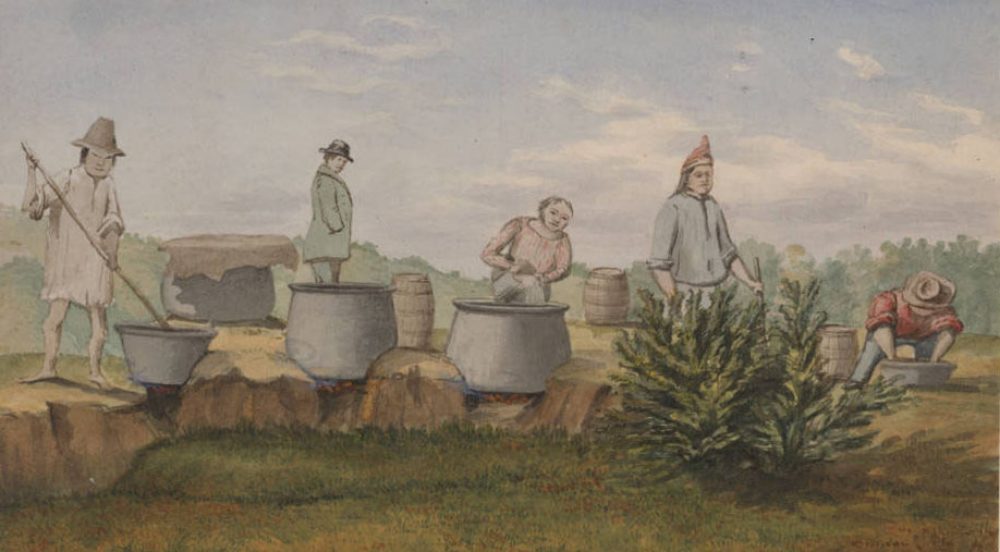
Vaqueros on the ground slaughtered in pairs, also doing the skinning. Indians on contract did the rendering of the tallow and any drying of meat.
WHD says the matanza season started in late July and went to October.


Rodeos for taming the herd

Vaqueros trained cattle herds to come to the rodeo ground when they were called.
WHD says they were driven in two or three times a week, then less often. Once trained, vaqueros only needed to ride out and call them, and they would come to the rodeo ground. Cows could bear as many as 20 calves in their lifetime, so it was well worth it to train them.
Darwin was told by gauchos in Uruguay that cattle organize themselves into tropillas, groups of from 40 to 100. If the tropillas are all herded together, cows will find their way back to their own tropilla in a day or two. It is likely that California vaqueros knew this, too.


HORSES
Only male horses were used for riding.
Riding horses were herded into caponeras, of about 25 head, which stayed together. Each had a yegua pinta, or pinto mare, as a leader.
WHD says on a rancho of 8000 head of cattle, there would be 12 caponeras, or about 300 head of saddle horses.
The Peraltas, and probably others, herded caponeras by color. WHD saw caponeras of all palpminos, blacks, and roans, three of the rarest hide colors.


Female horses were herded into manadas, of about 25 mares. Each had one stallion.
A new manada was herded during the day, and corralled at night, until they kept together on their own.


A remuda was the specific term given to a group of work horses assigned to a vaquero or brought for vaqueros’ use. Each vaquero had about 10 horses assigned to him. If he was lucky, some had good night vision and were good at night herding; some were short, stocky and strong, for roping; some were tall and fast, for going after strays, and some were like today’s cutting horses, which can tell which way a cow will go and control it.


A caballada is a drove of horses; more likely a military term than a cattlemen’s.


Other vaquero responsibilities
Vaqueros made their own reatas. These were usually a six strand round braid of rawhide. They were measured in brasadas, by measuring a length between a man’s hands stretched as far apart as possible. Many reatas were 30 brasadas, or about 80 feet long.
Vaqueros taught themselves to rope and ride. They were peerless at both.

Vaqueros in the San Joaquin spent the winter months breaking horses. They might saddle and ride a horse 12 times, then let it go until spring.


The quality of training varied. To “finish” a horse takes 7 years. “Finishing” means they understand and respond immediately to every signal and request the rider makes. Less trained, ordinary horses respond 30% of the time to signals, requiring repetition by the rider to obtain the desired action.


The yearly event “Extreme Mustang Makeover” (on video) shows that horses can become well trained in 100 days.


Also good to know

Sheep are seasonal breeders, which means they come into estrus in the fall when the days are becoming shorter. In the spring, all the sheep will be born within a month to six weeks.


Cattle are not seasonal breeders: they come into estrus all during the year, except when they are in milk. Thus, their calves, at branding time in the spring, will be any age from a few days to 12 months old.


Modern day cattle raisers control when the bull is put in with cows, or artificially inseminated, to ensure calves are born at the time of year they want. Californios did not do this. They kept about 1 bull per 25 cows, year round.


Steers, or castrated males, were not slaughtered until about 3 years of age or older. Cows were kept for breeding. A criollo cow could birth 22 calves in her life.
Dr. Brenda, a veterinarian on the TV show “The Incredible Dr. Pol,” said that horses are seasonal breeders. They come into estrus in the spring if they have no foal, or a couple weeks after they have given birth. As their gestation is nearly a year long, this means the foals are born at the best time of year for abundant pasture.


The Criollo Breed
Three Andalusian Spanish cattle breeds were brought with Columbus and then Cortez to Mexico. Several hundred years later, criollo cattle came from Baja missions and Tubac to the California missions. They were exceptionally well suited to open range ranching. One contemporary criollo breeder says “they never get sick. I have never had to pull a calf. They have tight feet for the rocks. They finish on pasture.”


In the tv series “The Incredible Dr. Pol,” one sees each week why this is wonderful and unusual. Northern European breeds, like Angus and Hereford, as well as dairy breeds like Jersey and Holstein, would often die without veterinary care. They get: digestive system problems like ketosis, acidosis, and displaced abomasum; birth problems such as too large a calf and breech birth, demanding the vet “pull the calf” to assist in delivery; and foot problems, making them too lame to sustain themselves.
Finishing on pasture means no purchased feed is needed to bring the calf up to slaughter weight.


The contemporary breed closest to what was brought to California is the Raramuri criollo. On the La Jornada Experimental Station, these are being compared to Herefords and Angus by the government, to determine which is the best desert breed. California Corriente cattle are close, as are Texas longhorms, but California criollo did not have long horns.
Abel Stearns said his cattle weighed in at 600 to 800 pounds. Contemporary cattle are deemed fit for slaughter at 1000 to 1400 pounds. By today’s standards, California criollo would be regarded as small.

References
Life on the King Ranch by Frank Goodwyn . Descriptions of jobs and processing cattle came from this book. The King Ranch owners imported virtually a whole Mexican town to initially supply workers. They taught the gringos the industry.


Severnty Years in California by William Heath Davis. Descriptions of rodeos and their different functions came from WHD.
Oxen Basics

Well, that was one of the most interesting things I’ve ever done!

Tillers International, near Kalamazoo, Michigan, has the mission of teaching people in third world countries how to use oxen for power, especially to plow and cultivate crops.  Each year they teach the beginner’s course, “Oxen Basics,” to whomever signs up.  Our tuition goes to support the overseas programs.

I arrived and after the introduction, somehow ended up walking down into the fields and groups of barns and buildings by myself.  There was no one else in sight when Marcos came along.  Now, Marcos is a very old ox that they no longer use in the yoke, but he gets to live out his life on the property, which is extensive, and if June is a measure, quite full of good green feed.  Marcos is probably still about 2,000 pounds and he was tossing his head around.  I had no idea who or what he was and some part of my brain must have frozen up, because I don’t remember how I got by him; after all, he was using the road, and he was bigger than me.

The trick about training oxen is get ‘em when they are still small enough for you to be able to pull them around and push their hindquarters over and restrain them if need be.  We had training sessions with two calves twice a day. They were nice enough not to run off but it was easy to see that getting the hang of what we were asking them to do….walk forward, stop, turn…. was going to take much repetition.

I had been around horses when I was young so it was not hard for me to approach and groom the team that had been taken out of pasture and tied to the hitching post.  It is a very interesting proposition, though, to be squeezed between two sets of ox flanks.  I got in between them often to groom them, and often felt this.  In some ways it was not unappealing; oxen are not bony, there was very little likelihood of getting kicked in that position.  It was funny, really.  But to do the work, I needed to learn the commands to move over, and did, more or less.

Their heads with the horns was a different matter.  We were told the oxen, and cattle in general, always know the size of their horns and their position in space.  After all, they don’t want to poke any other cattle in the eye or anywhere else unless they plan it.  But they do use the horns when they are establishing dominance, and that means, possibly with you.  The whole goal is for me to establish dominance such that the oxen obey me.  This seems simple when the calves are little.  It is a bit of a mystery why they allow it, when they are 2000 pounds and well able to not comply with any command.  They aren’t like dogs, which do what the owner commands to please the owner.  Or do they?  Not.

Dominance while driving oxen is created by body position.  Temple Grandin’s book Working with Farm Animals shows on one graph that even tamed cattle still retain a “fight or flight” response to humans coming near them.  It’s this rather small edge of their fear of us that we use to be able to control their movements.  If we move closer while oxen are walking, they will walk away from us.  Once we move further out, they will simply move along.  That, along with a buggy whip and your voice, is all you have.  It feels strange.

It made me very nervous.  Most of the others in the class had experience with either driving horses or cattle, or with moving cattle around pastures, etc.  Upon reflection, days later, I think more of what was making me nervous and tiring me out was I have so little experience with expressing dominance.  If you have kids, you learn this.  If you have dogs, you learn this.  I had neither, not even a husband.  But, you give the command, flick the whip end in the right place, and the oxen move out.  Initially, they moved in quick step and I got plain old tired attempting to run up to get in front of them for some commands, and running along when I was giving them inappropriate commands and this was their response.

Later, you walk an acre field.  Dan told me that to picture an acre, think of a football field, all the way out to the farthest corners of end zone.  That is an acre.  Then picture the work, which is, basically, walking up and down the field, over and over.  Whew.  Then, the terrain.  Tiller’s has nice soil, you sink in a couple inches when you walk on it.  If you’re walking behind the plow, it’s hard to figure out if you should put one foot in the furrow and one foot on top, or walk all in the furrow or all on top…… sigh.  About half the class and the two teachers could keep going, on and on.  The rest of us watched and took a turn once in awhile.

One morning was hot and very humid and we were to work dragging downed trees.  I got most of the way to the trees and I had already reached my body heat tolerance.  It was not going to be cool in the trees, so I turned back.  It turned out that the biggest kerfuffle happened in there.  Carter the off ox (right hand side) got his belly full of stinging nettles and took off.  Percy the nigh (left hand side) ox wrapped himself around a tree (that’s what they said) but luckily it was a  sapling and broke.  The picture given was not pretty.  In such a situation, the drover calms the oxen,  organizes them out of the mess they are in, and walks them until they are calmed down and can work again, all of which was done.

This situation was a danger to the oxen.  We were given many examples of situations that were dangerous for the drovers.  One-eyed drovers; being dragged from having your foot stuck in a loop of the chain; backing up while giving the command to haw and having the load hit you, etc.  Rather ruins your fun.  I came away feeling that I might get skilled over time, but there were too many danger factors to have this ever be simple fun.

Nevertheless the animals are fascinating, amazingly tolerant of stupid first-time drovers, and I came to know why Mexicans call them “noble.”

Tillers International also teaches classes like blacksmithing and coopering.  Their web site is:

http://tillersinternational.org.


ABOUT CABESTROS and HOLLERS

Until now, I have not been able to get any kind of corroboration in current cattle practices for the use of cabestros as described by William Heath Davis.  He writes:

“The cabestros had holes in their horns, with a small spike inserted, by which an unruly beast could be attached to one or two other cattle, so to be taken from one place to another, when necessary.”  William Heath Davis. Sixty years in California (Kindle Locations 815-820).

This lovely description of a ranchero gives another picture of their use:

“I knew Don Teodoro Arrelanes in Santa Barbara. He was a thorough ranchero. He was then perhaps fifty-five years of age, six feet in height, very straight, weighing 220 pounds; was genial and polite; had a numerous family, and owned extensive tracts of land, comprising many leagues; among them the Rancho Guadalupe, near Santa Maria, with as many as 20,000 cattle and thousands of horses. Among the rancheros he was looked upon as a kind of chief in that portion of country, by reason of his .good judgment and knowledge of matters pertaining to ranchos. On one occasion I said to him: ” Don Teodoro, how is it you have accumulated so much wealth— such an immense number of cattle and horses ?” He smilingly answered : ” The labor is to get the first 2000, and after that they increase very fast, under ordinary care and management. They require a great deal of care and thought, to make the best rodeo cattle and to prevent them from running entirely wild, and to make the horses useful for their purpose.” Sometimes cattle escaped from the ranchos to the mountains, forgot their former training, and became entirely wild; when vaqueros would go out into the  mountains, lasso them, and  bring them, tied to the cabestros, to be slaughtered or tamed.” William Heath Davis. Sixty years in California (Kindle Locations 2999-3015).  . Kindle Edition.

Please note Don Teodoro saying “to make the best rodeo cattle.”  What he means is that they come when they are called.  See my blog post about Herding Practices: although the Darwin reference is from Rio de la Plata and not California, the practice was the same.

Another example:

“Senor Vejar offered to sell me seven hundred head of tame milch cows, many of them with suckling calves, and fifty head cabestros, for seven thousand dollars.”  William Heath Davis. Sixty years in California (Kindle Locations 9349-9342).  . Kindle Edition.

This shows that cabestros were numerous, 50 of them with 700 cows.  Davis does not say whether they are steers or cows; I believe they were tamed steers.

I met Dan Stein, Professor of Animal Science, Oklahoma State University, at a class I just took at Tiller’s International, “Oxen Basics.”  When I told him about cabestros, he related that donkeys were used for that purpose, to tame unruly calves.  The donkey would have a strong collar, and the calf would be tied to it.  He said there was just enough length in the rope for the donkey to manage the calf by kicking it.  The donkey would not allow the calf to eat until he allowed it, and took it along wherever he went.

I think Californios used tame cattle for the same purpose, just as Davis described it.

Steve of the Georgia Museum of Agriculture and Historic Village said he has Pineywoods cattle, which are descendants of Spanish cattle left in Florida.  Besides having “pig hollers,” or a special call or yell  that the pigs will come to, there were “cattle hollers” in this area.  The cattle could tell their owner’s holler and would only respond to that one.  This reminded me of herding in California:

“Then, whenever the herd was wanted, all that was necessary for the vaqueros to do was, say twenty-five or thirty of them, to ride out into the hills and valleys and call the cattle, shouting and screaming to them, when the animals would immediately run to the accustomed spot; presently the whole vast herd belonging to the ranch finding their way there.”  William Heath Davis. Sixty years in California (Kindle Locations 757-760).  . Kindle Edition.

I wonder if rancheros each had their own, different “holler.”


No fighting bull genes, sorry!


I have read today, yet again, that a historian believes that the original Spanish cattle that developed into the criollo had De Lidia, or fighting bull genes.  I thought Rouse had put this idea to rest years ago, apparently not.

There are many reasons why it’s just not possible:

  1. (See below), breeding records were and are kept for the fighting bulls. That means they would have been kept isolated, so that the bull whose genetic heritage was the chosen one, would be the only one with access to the chosen female.  This means enclosures, not free range pasturage, as virtually all cattle were kept in New Spain (and Alta California.)
  2. You are thinking, well gosh, the bull would have been allowed to run around with the ordinary cows, huh? Probably not: no one would want the trouble of bringing him back in by force.
  3. Behavior issues: cattle may get cranky but they are not bred to be aggressive, as are the De Lidia fighting bull. You don’t want their genes in your regular stock.
  4. Behavior issues, this time human: the owner would have been so proud of owning such valuable stock, that it would have been kept specially.
  5. Rouse describes conformation, which is the way an animal looks. Even a non-specialist like me can tell the difference in breed of the De Lidia and the foundation stock of criollo.
  6. Scarcity: Rouse tells this story:

“The bullfight was an institution, and progenitors of the De Lidia were selected for aggressiveness.  They would have differed widely in this trait from the old red cattle of Spain, the progenitors of the Retinto.  The fighting animals have heavy forequarters, a narrow rump, and are well cut up in the flank, and in conformation bear no resemblance to the Retinto, which lacks the heavy shoulders,  has a fairly well-rounded rump, and a level middle.  There is a marked difference in horn shape on  the two breeds, particular on the female.  The De Lidia cow has forward thrust horns, with a moderate upturn towards the ends.  The Retinto has much larger horns, widespread and with a distinct upturn.  The color of the Retinto is invariably red or dun or brown, a narrow color pattern, and always solid over the body.  The De Lidia, which has an older written record than any breed of cattle, is known to have been quite varied in color—black, gray, red, various combinations of these colors, and even brindle.  There was certainly a wide divergence in color, as well as other characteristics, between the Retinto and the fighting stock as far back  as there is any evidence.

“There is a record of ‘12 pairs of bulls and cows…..the oldest fighting bull stock in Mexico’ being taken to New Spain [Mexico] in 1552.  This was evidently a very special cattle shipment, arriving as it did four decades after the indies had received its base foundation stock from which the Western hemisphere was populated.  By 1552 the cattle population in New Spain must have reached at least a few hundred thousand— Coronado had entered what is now United States territory twelve years earlier with 500 head.  It is obvious that 24 head of De Lidia cattle, or even several shipments of this size,  all of which would have been carefully segregated from other cattle, could not have a significant impact on the national herd of New Spain.  (Rouse, John E. Criollo: Spanish Cattle in the Americas: University of Oklahoma Press, 1977. p. 20-21.)

So, to review  Rouse: the three cattle breeds from Spain that gave us the criollo were the Berrenda, the Retinto, and the Andalusian black.  No De Lidia.


Appreciating rawhide

One afternoon when at Sutter’s Fort I pointed out to a visitor some of the uses of rawhide.  She said, “oh, like dog chews.”  Dog chews are indeed one of the only contemporary uses for rawhide.  But in the mission era, it was so important, that it is listed on Santa Barbara presidio orders to Mexico city for supplies.

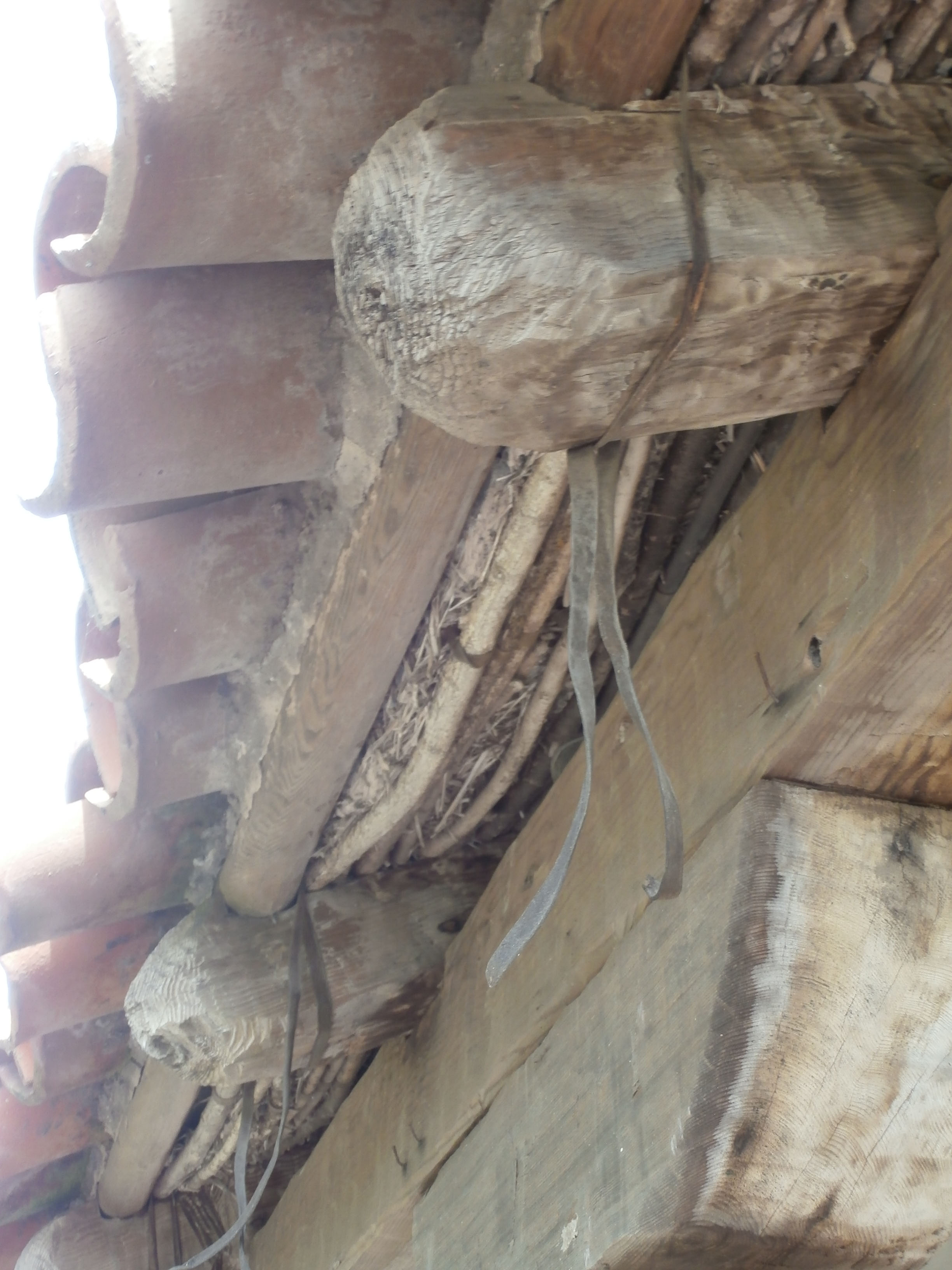
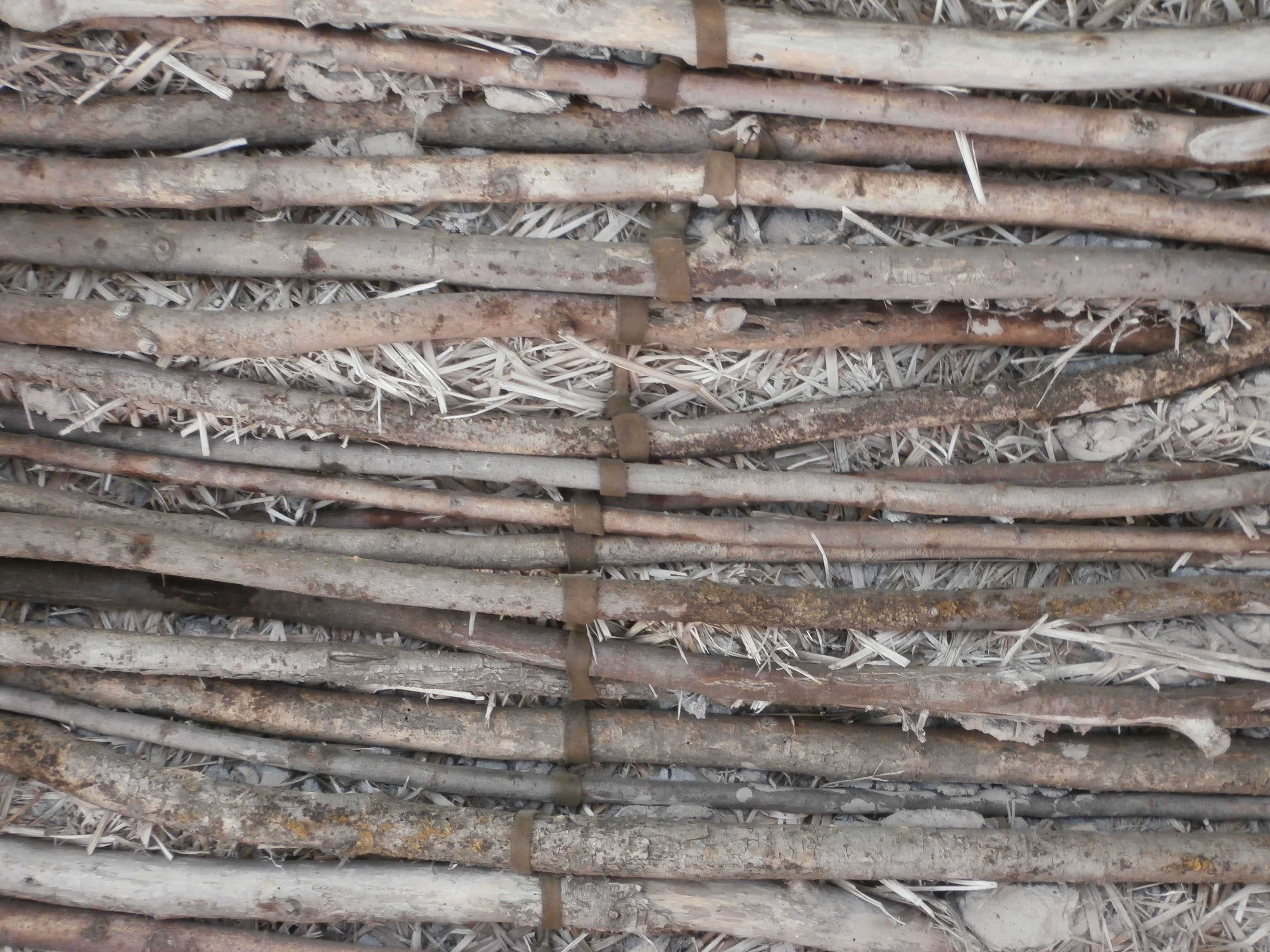
I am writing this still feeling the excitement of visiting the Santa Cruz Mission and taking a gander at the roof of the only original building, the neophyte housing.  Here is what I saw:

OLYMPUS DIGITAL CAMERA

This was the first thing that caught my attention.  This rawhide weaving looks like a dark brown stripe down the middle of the roof understructure, in between the beams.  This close up shows how it was done.  The technique was also commonly used for making ramada roofs.  I have not yet found a description of a ramada from the time period, but many assume they were simple structures, four poles holding up a roof.  In the Gold Rush era, even a stack of branches with a piece of cloth over it could be called a ramada.

The long sticks are laid out on the ground, and two long pieces of rawhide are tied to each other and to the first stick, in its center.   One rawhide strip wraps around each side of the first stick, then cross over each other, and another stick is added, and  the strips crossed over them again.  I do not know if this weaving was done in place, on the roof structure, or on the ground and then tied in.  I am guessing they did it on the ground and then installed it with the vegetation that you also see here.

Rawhide is worked wet, so when it dries, it shrinks.  These sticks are still held firmly.

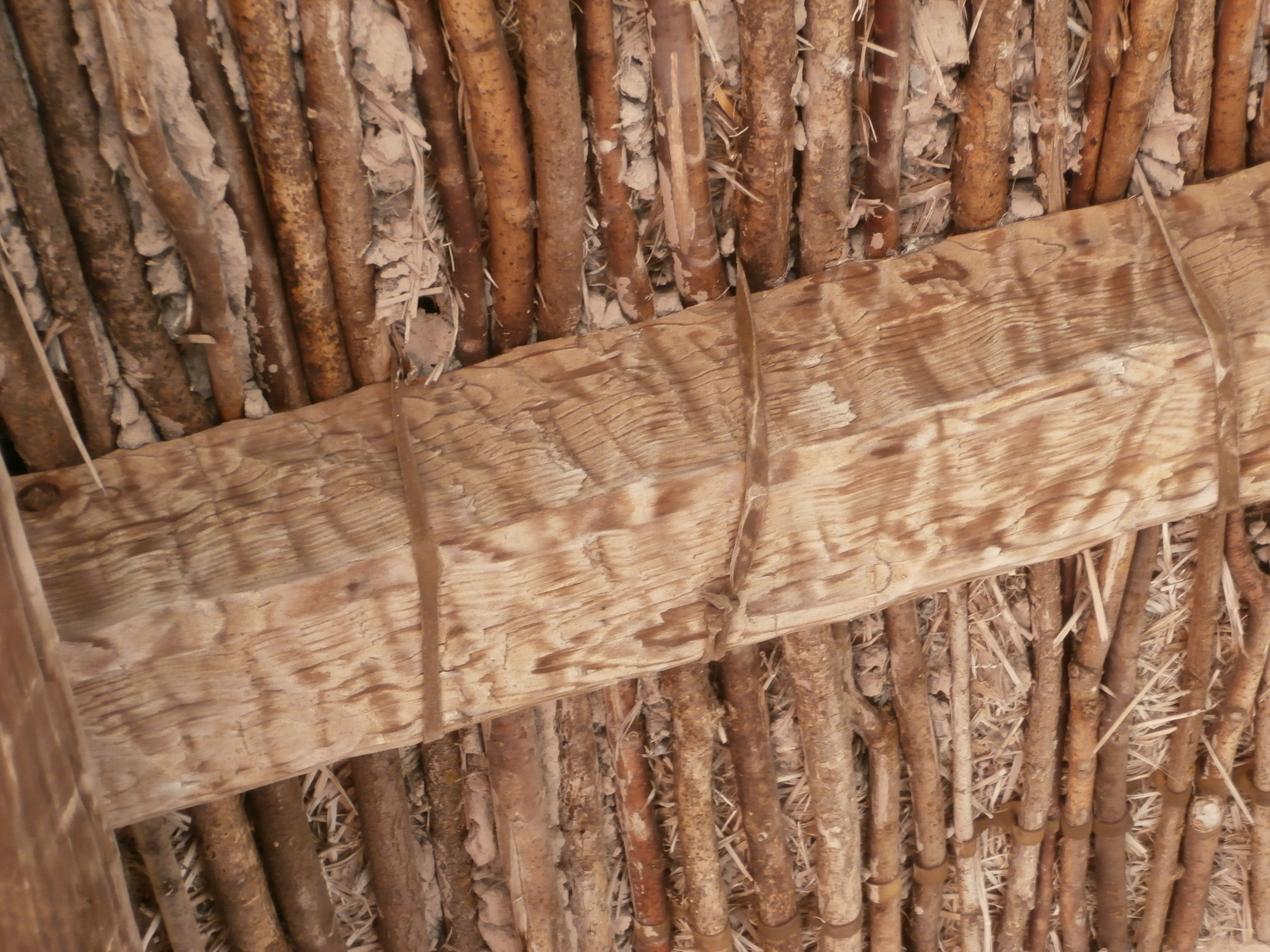
The next step was to tie these “mats” of woven sticks to the beams.

OLYMPUS DIGITAL CAMERA

Here you can see they “sewed”  the woven willow mats onto the beams.

They tidily knotted it off and the tail ends can still be seen sticking out.

OLYMPUS DIGITAL CAMERA

Other important uses for rawhide were:

Holding together saddle trees: picture thanks to Rod Nickel Saddle Trees:

OLYMPUS DIGITAL CAMERA

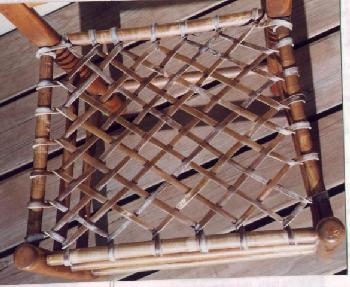
For chair bottoms: picture thanks to Randy S. Keeling:

RawhideSeatrandy s. keeling

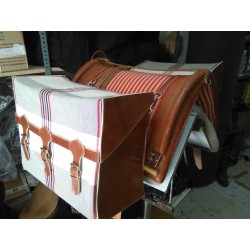
In a tiny hamlet near a mission in Baja a man had created his own museum.  I apologize for breaking my camera before I got there, but here was a wonderful use of rawhide, a pair of alforjas, or saddle bags.  But really, they were more like pack saddle boxes.  Each looked like it had been cut from one hide; the hair was left on, on the outside; the box itself measured at least 15 X 15 X 20, that is, bigger and boxier than a carry-on piece of luggage, and like some Rubbermaid storage containers. It had a cover with a flap over the side.  They were big! And stiff, unlike many other pack saddle bags, which are of canvas and soft.  I could have packed a complete set of fine china in them, and gotten them up Baja trails with no breakage.  The closest example I have found on the net is below:  but it’s much smaller, and much too well made to compare.

alforjas-cuero-y-lona-fp

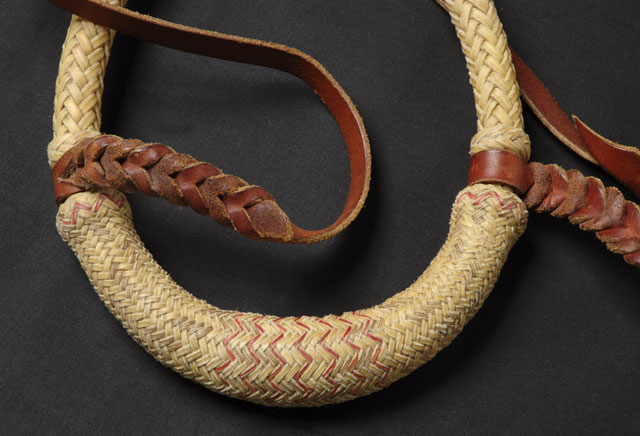
Luis Ortega is renowned for his cuero crudo  work.  Here is a close up of the honda on a reata he braided (thanks to the Autry)

ortega honda autry

Here is a close-up of the top of a jaquima or hackamore, (thanks to the Autry):

ortega hackamore detail autry

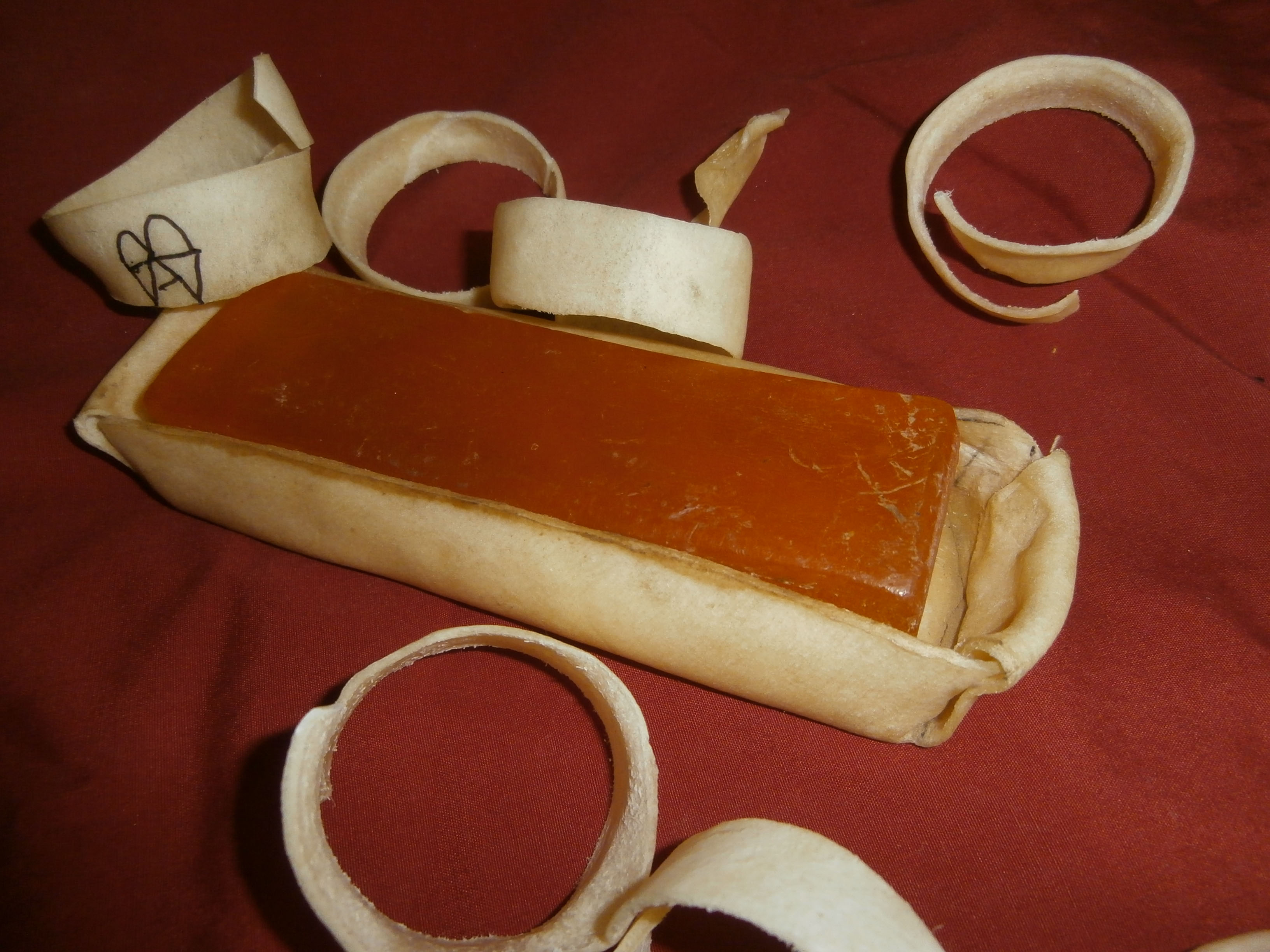
Last are a couple things I did with rawhide remnants, bought on ebay from White Bear Leather: a half pound gives you plenty to mess with.  These are bracelets I made by wrapping strips around cans of the right size, taping them on, and letting them dry.  My brand is on one.  The other is a holder I made for the bar of glycerin saddle soap.  I also punched out some buttons which did go through the wash but turned oval instead of round.  Have fun!

OLYMPUS DIGITAL CAMERA

Vaqueros, Cowboys, and Buckaroos, by Lawrence Clayton, Jim Hoy, and Jerald Underwood. 

Review of Vaqueros, Cowboys, and Buckaroos, by Lawrence Clayton, Jim Hoy, and Gerald Underwood.  University of Texas Press: Austin, 2001.

I wish the publishers of Western history books would find readers of the final draft.  Surely someone at the Autry could have pointed out that the “vaquero” section was curiously lacking, or just plain wrong, in the areas of equipment and dress.  The mochilla style saddle is not shown or mentioned, nor are garrochas, or desjarretaderras, (media lunas): and the Autry has examples of all of those.  The stirrup described is a later development, and braided rawhide riendas not shown.

The historical content, thus, becomes highly suspect.  Much of this sounds like it has been written backwards: that is, the author works back in time from what he knows of Texas.  Most cattle industry historians do this, to some extent, instead of attempting to find original documents from the period, or historians working in allied areas.  Clayton has never found Bishko, Sluyter, or, (huge sin) Rouse.

So, he says Texas longhorns were a crossbreed including “ganado prieto,” the fighting bull.  Rouse’s description of the importation and segregation of the de Lidia fighting bulls makes this extremely unlikely.  Plus, the origin of the longhorn as a “land race,” detailed in Rouse, is not covered.  Herding practices are not covered.  Spanish laws governing cattle are not covered.  I believe these are fairly well documented and findable.

What is not yet documented well, as far as I can tell, is also not covered here.  I would give my eye teeth for a book that:

–covers early peninsular (Spanish) cattle practices in more than anecdotal fashion;

–covers the development of estancias in New Spain;

–finds more “saddle proof” of Sluyter’s theory that the saddle horn was developed early, in Vera Cruz;

–finds written records of how many vaqueros were trained and used on missions and ranchos;

–finds records of what the Padres had available to them as instruction in the care of cattle on the missions;

–finds a first person account of a matanza, including output, daily slaughter, and how and who staked out 100 hides at a time. Sluyter has a description of a slaughterhouse for making tasajo in South America, which is detailed enough to draw a picture and set a timetable.  We have no such description for Nueva Espana or Alta California.

After all, the story is not a bunch of guys riding around on horses.  It’s an industry harvesting and selling a line of products.


PANDEMICIDE

There is no word in English for mass deaths caused by the introduction of new diseases for which a population has no immunity.  I coined a couple possible terms and emailed  Charles C. Mann, author of 1493.  He liked “nonagimate,” which, like “decimate,” would refer to the numbers dead, that is, nine out of ten for “nonagimate” rather than one out of  ten for “decimate.”

But we both agree that “pandemicide” is more easily understood as soon as one sees it.  So start using it and pretty soon it will be in the dictionary…..Barb


Roping

From descriptions of vaqueros who wrote about their work in the early 20th century in the lower San Joaquin valley of California, I can tell that most of what here are called “tricks” were standard “catches” used on cattle.  Will Rogers uses a man on horseback to demonstrate them, because a horse is easily controlled to run, stop, and repeat, unlike a cow.  The 80 foot reata was common, and so were the longest throws seen here.  Will Rogers was a wonderful showman, but many ordinary vaqueros could have shown him up.


Continuity of Horse and Cattle Practices in Alta California

Talk given Feb. 2017, California Missions Foundation conference, Santa Ines Mission

The practices of the cattle industry have changed profoundly since the early 1800s.  Because of this many of the first person accounts of Californio horse and cattle practices sound either fantastical or just plain odd.  I recently read The Nature of Horses by Stephen Budiansky which explains the good sense of many Californio practices.  Here are some of what I think are the most interesting ones. Most of the quotes are from William Heath Davis’ book 75 Years in California.

“To account for the fast traveling in California on horseback, it is necessary to explain the mode by which it is accomplished.  A gentleman who starts upon a journey of one hundred miles, and wishes to perform the trip in a day, will take with him ten fresh horses and a vaquero.  The eight loose horses are placed under the charge of the vaquero, and are driven in front, at the rate of ten or twelve miles an hour, according to the speed that is required for the journey.  At the end of twenty miles, the horses which have been rode are discharged and turned into the caballada, and horses which have not been rode, but driven along without weight, are saddled and mounted and rode at the same speed, and so on to the end of the journey.” p. 27, Bryant, Edwin, What I Saw in California.

Edwin Bryant actually did ride this way from San Jose to San Francisco, sixty miles as he stated, with stops for lunch and a breather, and it took them from 11 AM to dusk.  This riding was commonplace.

Budiansky explains how it is possible:

“The zoologist C. Richard Taylor made an extensive study of energy consumption in animals traveling at various gaits.  He trained animals to run on a treadmill whose speed could be varied, and he calculated energy consumption by fitting the animals with face masks that measured how much oxygen they consumed as they worked.  When he studied horses (actually Shetland ponies) he found a striking pattern. At each gait- walk, trot, and gallop—there was one narrow range of speed where energy consumption was lowest.  These optimum speeds were almost precisely the same as the speeds the animals themselves naturally chose at each gait.”

Horses, whether at a walk, trot, or gallop, will choose the miles per hour rate that is most energy efficient.

“When the ponies were forced to move at an unusually slow or fast walk, the energy they spent to move a given distance shot up; the same thing happened at the trot and canter.”


This helps prove that a most efficient speed exists in every gait.

“Another remarkable finding—and one that has been shown again and again in other animals—was that the total energy expended in traveling a kilometer at a walk, a trot, or a canter WAS EXACTLY THE SAME, so long as the ponies were allowed to move at the optimal speed for each gait.”

What this means is, that horses are not like us humans. If we want to lose weight by using up more energy, we jog or run. But a jog or a run, for a horse, uses the same amount of energy as walking, as long as he can choose his pace. Budiansky’s book has explanations of the physics involved that allows this to occur.

So, the Californio practice or riding at a canter, which is 10 to 17 mph, uses up horses’ energy just as fast as walking them does.

Back to California:

“The horses were never stabled.  They were broken for the saddle only, and were almost wholly for herding cattle.  They were divided up into caponeras, or small bodies of about 25 each, each caponera having a bell mare, which was always a yegua pinta, (calico mare,) having a beautiful variety of color, whom they followed, and so accustomed were they to their leaders that the different little bands never mixed; and if by chance one got into the wrong company he would presently go back to where he belonged.” “On a rancho with 8,000 head of cattle, there would be, say, twelve caponeras.  One or two of these divisions, containing the best horses, were specially for the owner of the rancho.” WHD

Budiansky says horses have good vision and are easily capable of telling one horse from another.  They form pair bonds like friendships, and form a social dominance hierarchy based on personal space, and preferential access to resources.  The band leader is not always the most dominant horse but often the oldest mare.

Budiansky: “But so general is this drive to bond that it appears within horse society in many contexts that have nothing to do with mating.”

The term caponera was used specifically for these bands of riding horses, not for stallion-centered breeding harems.

“The breeding mares were divided up into manadas, or little bodies of 25, with a stallion for each, and so accustomed were they to follow their stallion that each band kept distinct and never mixed with other manadas.  The stallions were equally faithful to those under their charge, and never went off to other bands.”

“It was the custom of a stallion, on the approach of a strange horse or number of horses, to circle round his mares, keeping them well together, and driving the visitors away, so jealous were they of intruders.”

“The manadas were formed at first by the vaqueros herding the band during the day, and at night securing them in a corral.  They continued this day after day until the animals had become so accustomed to the arrangement that there was no danger of them separating.  They were then left to go free, and continued together month after month and year after year.”

“A stallion when taken away from his manada and confined in a corral would squeal and neigh and manifest the greatest uneasiness and anxiety until restored to his company.”

“Except for this training to form them into manadas, these mares were entirely wild and unbroken.  They were never used for riding, and only occasionally for work at the harvest season.”

The research that Budiansky uses is from contemporary feral horses in the Western United States.  In those conditions, the average manada is four or five mares and their foals, with the stallion.  This is a much smaller grouping, but other factors hold true.  Once a stallion has a manada, he will not search out additional mares.  His mares will obey his commands to move along in a direction he drives them.  These manadas are nomadic, but tend to keep in a favorite territory, and there is evidence that stallions will use the scent of each other’s droppings to avoid each other, where these territories overlap.  The stallion will threaten any outsider approaching, as described by Davis.

There is anecdotal evidence from people who keep horses and pasture them together, that when new horses are included, their place in the social hierarchy is worked out very quickly, within days.  The herding that the vaqueros would do, would function to keep the group together long enough for the social hierarchy to form.

There is one other Spanish term for a grouping of horses, and this is “remuda.”  A remuda is a group of horses specifically ridden by one vaquero, or one rider.  A remuda consists of six to ten horses.  Vaqueros did not usually own their own remudas.  A newly hired vaquero would get the worst of the lot and gradually work up.  In the southern San Joaquin valley in the 1920s, Rojas tells us that each vaquero would be given five horses to break to saddle in the fall.  He would saddle each ten to twelve times, over several weeks, then let them loose until the spring branding started.  It is likely that this was the same routine practiced for several hundred years.

To move on to cattle:  vaqueros also assisted in creating cattle herds or tropillas, in Alta California:


“Although the cattle belonging to the various ranchos  were wild, yet they were under training to some extent, and were kept in subjection by constant rodeos. (Rodeo here means a round up; it also means the place they are taken to; it does not mean a competition as it does today).  At stated times, say two or three times a week at first, the cattle of a particular ranch were driven in by the vaqueros, from all parts thereof, to a spot known as the rodeo ground, and kept there for a few hours, when they were allowed to disperse.  Shortly they were collected again, once a week perhaps, and then less seldom,  until after considerable training, being always driven to the same place, they came to know it.  Then, whenever the herd was wanted, all that was necessary for the vaqueros to do, was, say, twenty-five or thirty of them, to ride out into the hills and valleys and call the cattle, shouting and screaming to them, when the animals would immediately run to the accustomed spot; presently the whole vast herd belonging to the ranch finding their way there.” p. 58 WHD

Charles Darwin in The Voyage of the Beagle describes the behavior of cattle that makes this possible:

“The chief trouble (meaning daily work) with an estancia is driving the cattle twice a week to a central spot, in order to make them tame, and to count them.  This latter operation would be thought difficult, where there are ten or fifteen thousand head together.  It is managed on the principle that the cattle invariably divide themselves into little troops of from forty to one hundred.  Each troop is recognized by a few peculiarly marked animals, and its number is known; so that, one being lost out of ten thousand, it is perceived by its absence from one of the tropillas.  During a stormy night the cattle all mingle together; but the next morning the tropillas separate as before; so that each animal must know its fellow out of the thousand others.” Darwin, p. 150.

You may wonder as I did, how big a space a rodeo full of cattle might have been.  Here are my estimates: one of the first feed lots in Lubbock, Texas, held 35,000 cattle, and was 125 acres.  I used a feed lot because the animals are kept close but not crammed in, and 35,000 was a possible herd size for a mission.  This much acreage is the equivalent of 56 city blocks, using the engineering standard of 2 1/4 acres per city block.  To picture that, picture a piece of land 7 blocks by 8 blocks.  If you also picture  one vaquero per city block on the perimeter, to keep them in order, that is about 30 vaqueros, which would not have been an unusual number to take care of 35,000 head.

I personally think that rounding up a whole mission herd was rarely done, if at all, but this shows that it was possible.  The rodeos that happened twice a year, were for the work of either slaughter, or for branding and castrating, and took several months to accomplish.  The vaqueros would have only brought in as many cattle as could be processed in a few days.

(look at Criollo cattle on wikipedia for the photos of Spanish cattle I gave with the talk.)