This is my Vaquero room “spiel” edited to an essay.
Swiss-born Captain John Sutter claimed to have about 8,000 head of cattle, including 1,700 acquired from the Russians after he purchased Fort Ross on the north coast. He also bought cattle from other ranchos around San Francisco Bay, which usually had an average of 1,000 head per square league of land.
Sutter probably ran his herds south of Sacramento towards Elk Grove, and north and east of the American River, towards Hock Farm. He had a way of utilizing all the resources within his reach. He was not the owner of the expanse south of Sacramento, nor the “Piney Woods” where he was building his sawmill when gold was discovered.
According to a vaquero friend of mine who is well versed in these matters, managing cattle requires one man per 1,000 head.[1] Our English word buckaroo comes from the Spanish term vaquero (cowhand). Other cattle industry terms of Spanish origin include:
la reata: the lariat (a braided rawhide rope used to capture animals)
el lazo: the lasso, another word for reata
rodeo: round-up
dar la vuelta: to dally (wrap one end of the rope around the saddle horn)
la estampida: the stampede
un/una mesteño/a: a male/female mustang; unclaimed horse
el rancho: the ranch
el ranchero: the rancher
la remuda: the re-mount (string of replacement horses)
Initially trained to manage herds on mission cattle ranches (estancias) and later on privately owned ranchos, vaqueros were highly skilled, salary-earning professionals. Most were former mission Indians who “went freelance” after secularization in 1834, when mission churches were turned over to parish priests.
In Spain or Mexico, two round-ups per year would have been the custom: in the spring to brand the calves, and in the fall for slaughter.[2] The cattle industry developed in Spain during the Middle Ages, when much of the Iberian Peninsula was sheep country. As the Spanish, pushing southward over several hundred years, gradually took back portions of the Peninsula from the Moors who had conquered it in 711, regional nobility awarded land to cattlemen.[3] In northern European countries like England and Denmark, a wealthy farmer might have a couple hundred head, while in Andalusia (southern Spain) a well-to-do townsman might have that many, and a hacendado (owner of a large hacienda) would have owned thousands.[4]
The development of the cattle industry went hand in glove with the development of equestrian culture because skilled horsemanship was essential for controlling such large cattle populations. While in the saddle seven days a week, a vaquero needed seven or eight horses in his remuda.[5] When searching for cows that had wandered to distant pastures, he would ride out at top speed, daily using different horses in turn. Vaquero work can be dangerous to both horse and rider. The cowhand can fall off his horse. He or his mount can get gored by a bull. He can lose one or more digits if the rope traps his fingers around the saddle horn as a cow goes running off with the loop around its horns.
Until the 1850s, cattle in the West were what is now known as criollo.[6] The very first of the breed were brought on shipboard by Columbus–one bull for every ten cows. Once acclimated, they were trained to form groups of twenty-five cows with a single bull. Gradually, Spanish explorers and colonists released cattle in many parts of North America, including today’s states of Florida and Texas. From the 1500s to the 1800s, those cattle without human supervision developed into what is called a “land race.”[7] Texas longhorns are a land race.
The Spanish brought cows of three basic breeds from Spain. The fighting bull, or toros de lidia–was the first breed for which breeding records were kept[8]. It is a particularly aggressive breed of black bull with strong forelegs and a humped neck, very different in appearance from the criollo.
Prior to the arrival of the Spanish, the American continent had only undomesticated bison in the northern hemisphere and domesticated llama, used as pack animals, in the southern hemisphere. Horses, cows, mules, donkeys (burros), sheep, goats, and pigs were all brought from Spain as part of a world-altering exchange of biological and botanical life forms known as “the Columbian exchange.”
Cattle raised on vast expanses of Alta California mission lands began to be a big money-maker after 1821, when the Kingdom of New Spain won its independence, becoming the Republic (and for a short time, the Empire) of Mexico. When Alta California belonged to the Spanish empire, its colonies could only trade with the motherland. After Mexican independence, ports in the Northern Pacific were opened to international trade as long as all ships first stopped in Monterey to pay import duties of up to !00% on their trade goods.
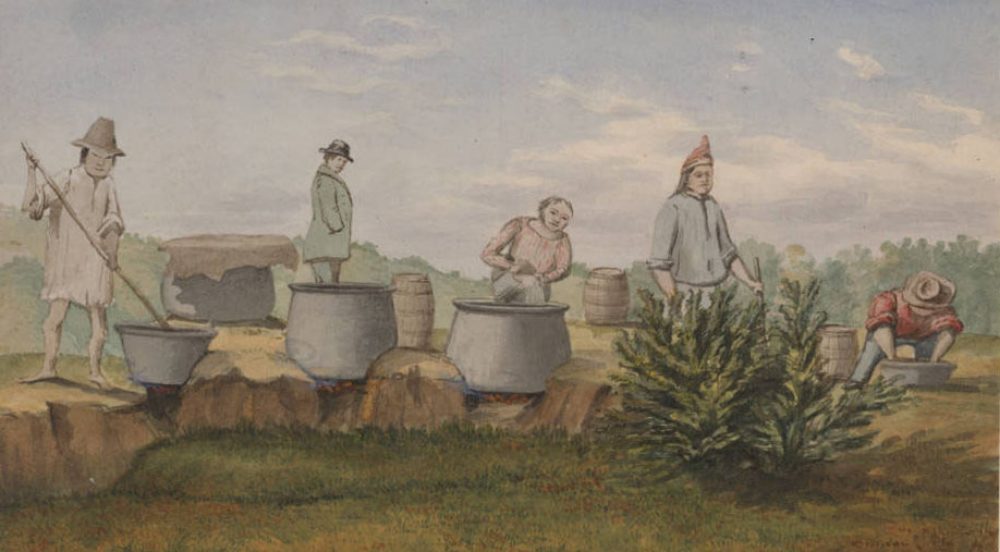
In England and the young United States the steam engine, patented by James Watt in 1781, was used extensively for manufacturing and transportation. These engines needed leather belts to transmit mechanical energy. Alta California hides met that need, creating a market during the mission era. Hundreds of cattle were slaughtered at one time, the hides stripped off, and the fat rendered down and sold as arrobas (25-pound quantities) of tallow. Traded for two dollars each in lieu of coin, which was rare, a hide came to be known as a “California bank note.” Some American ships packed as many as 40,000 hides for transportation to the factories of Boston.[9] “Tallow boats” came from South America to buy tallow, which was used to manufacture soap and candles, and for food in the mines of Peru.
We think of the purpose of our cattle industry as the production of table meat but in early-1800s Alta California, rancheros discarded most of the beef for lack of local demand, lack of transportation, lack of labor to dry it, and lack of refrigeration to preserve it. Instead, they left it to rot or be eaten by bears.
William Heath Davis was one of the Americans who traveled around San Francisco Bay by boat, collecting hides and tallow from various ranchos. His book relates how vaqueros used to entertain themselves at a matanza (slaughter). When Davis had to spend the night at a slaughter ground, he would pitch a tent near his boat. One night after dark, grizzly bears came prowling around the carcasses. They were busy eating their fill when a group of vaqueros came riding in, releasing their reatas and strangling the bears. Three of the grizzlies, having escaped, ambled over to where Davis was camped, keeping him wide-eyed and on edge the entire night. Obviously, he survived to tell the tale.
Captain Sutter traded in hides and tallow, and also dried some proportion of the meat. A surviving record tells us that he sent a one-hundred-pound sack of dried meat to Hock Farm via launch. Later on, he would more likely have kept the tallow to make candles and soap, and the hides to be tanned at his tannery.
Davis recounts how manteca (lard or soft tallow from under the hide) was sold to the Russians for food. Sebo is hard fat from near the innards. According to Davis, 40 pounds of manteca and 80 pounds of sebo could be obtained from a single animal.[10] It takes about three pounds of raw fat to render down into 1 pound of tallow. If an arroba of manteca sold for two dollars, an arroba of sebo for $1.50, and the hide for $2, each animal would have been worth about $4.50.
The reason the meat was not traded was because its worth did not offset the cost of shipping it around the Horn of South America. By contrast, Río de la Plata ranchos in present-day Uruguay and Argentina did a brisk trade in dried and salted meat known as tasajo. In comparison to rounding the Horn, the voyage up the Atlantic coast of South America was easy. South American ships sold tasajo to Cuban slave owners as food for their slaves.[11]
At Sutter’s Fort, Captain Sutter was feeding as many as 300 people a day–primarily on beef, it can be assumed, because of its role as a staple of the Californio diet. Travelers describe what they ate when staying overnight at ranchos. The menu invariably included beef cooked several ways, along with beans and tortillas made from either corn meal or wheat flour. Diners might consume as much as a pound of beef at each meal.
A criollo steer weighing about 850 pounds produces 500 pounds of meat.[12] Working vaqueros could easily kill two per day, producing 1000 pounds of meat, to give each of 300 workers their ration.
The vaqueros whom Sutter hired had been trained at the missions or on private ranchos. Many remained on a particular ranch, where they married and raised a family[13]–unlike the Texas cowboys, loners who rambled far and wide.
Illustrated on old maps, the cattle pens outside the gates of Sutter’s Fort were probably used for oxen and horses belonging to visitors. The visiting animals would have been watered every day by being driven down to the river.[14]
Sutter’s herd would have expanded quickly. The gestation period of a cow is nine months. Heifers (female cows that have not yet produced two calves) are ready to be bred at the age of nine to twenty-two months.[15] A horse’s gestation period is 11 1/2 months, and mares come into heat soon after they give birth. Therefore, each mare could potentially produce a new foal every year and each cow a new calf every year.
Examples of brands that Captain Sutter registered as part of his role as a Mexican government official are attached. Using a hot iron to mark each animal as individual property is a custom that dates back to the ancient Egyptians. Earmarks were also registered. A notch was cut in the cow’s ear, or sometimes half an ear was lopped off, to indicate that an animal had been sold to another owner. Sheep and goats were usually earmarked rather than branded.
A blacksmith would have made the branding irons, but vaqueros made and repaired some of their own equipment. Their reatas were made from braided rawhide. Here is how they did it. First, they would scrape any remaining meat and fat off the fresh hide. Then they would cut one long piece of hide in a continuous strip, on a spiral, starting at the outside and moving to the center. This piece would measure an inch or less in width. They would then stick a very sharp knife down into a piece of heavy wood and pull the strips against the blade, slicing them smaller. This would be done twice, to get four strands, which would be strung between trees to stretch them while the hair was scraped off. They would then be braided and rolled so they were sufficiently stiff to hold a loop open when thrown.[16]
The reata (lasso) needs to be fairly stiff in order to make a loop over the head as you’ve seen cowboys do. Lassos, usually about 30 feet long, can be as long as 80 to 120 feet – the maximum distance from which a vaquero can sail a noose and land it around his target’s head or feet.
The rope is used to control the cow. When vaqueros want to bring a cow down, one will rope the horns and another will rope a back leg. Each will “dally,” or take a turn of the rope around the saddle horn to secure it. As their horses pull back, the cow will drop onto her side. A third vaquero can then brand it or tie its legs together before it is slaughtered.
Slaughtering is done at a matanza, always staged at a place where water is available to clean up. Large slaughters were organized near waterways where hides and tallow could be picked up by boats.
Other pieces of equipment include the garrocha–the long, sharp-ended rod in the vaquero room–used to separate animals in close quarters like pens.[17] Vaquero soldiers used both the reata and the garrocha during the Mexican American War, the garrocha was like a lance to chop at enemies, and the reata to unhorse enemy riders.
This kind of saddle is called a charro by Mexicans who have continued the vaquero tradition, also referred to as charros. The piece of leather on top is called the mochilla.
This is the same saddle that the pony express riders used. Theirs would have four boxes attached to the four corners of the mochilla. Three would stay locked all the way from St. Joseph while the fourth would be used for local mail. When the pony express rider came into the place where he was to change horses, he’d pull off the mochilla, but not the whole saddle, and put it on his waiting remount.[18]
A man named Andrew Sluyter has an interesting theory about who developed the use of the saddle horn. He writes about “herding ecologies,” his term for how herds were cared for by man, and what tools they used to do so. In Spain and early Nueva España (today’s Mexico), the saddles didn’t have horns, and the rope was only used for pulling out cows that had gotten stuck in the mud.
In Vera Cruz, Mexico, the garrocha was used to move cattle while the desjaretaderra (hamstringer; or media luna) cut the hamstrings and brought down the animals for slaughter. In 1546 use of the desjaretaderra was outlawed, but the ban was only enforced against vaqueros of African descent.
Sluyter argues that West African slaves shipped to New Spain would have remembered the horned riding saddles common in West Africa, where horns had been designed for gents to rest their hands on, not for roping. The West African slaves, coming from a herding ecology that used ropes from the ground, not riding horses, used ropes on cattle when they were acting feisty. They would rope the animal’s horns, tie the animal to a big log, and let it tire itself out by pulling the log around. Sluyter contends that those men were probably the first to use a saddle horn for roping. The first written evidence of the practice dates to Texas in 1769, when that future state was still part of New Spain.
Spurs were an essential part of the vaquero’s gear. Rowels look like they might have been made for stabbing into a horse’s side in order to make him go faster. I once asked a cowboy who was visiting Sutter’s Fort, “What should I say about how spurs are used?” He explained that if the rider moves his leg backwards and taps the side of the horse, the horse will move its hind end over. If the cowboy moves his leg forward and taps, that signals the horse to move its front end over. The cowboy’s goal is to keep the cow in front and a little to the right side because from that position, he can most easily throw a loop over the horns of the cow and bring it down.
A horse’s jaw has cutter teeth up front and molars for grinding in the back; in between is a space without teeth. That’s where the bit for the bridle sits, which explains why it does not clank against the horse’s teeth. Bits are made to fit the horse’s mouth without pinching the sides. The bit is not used for leverage–that is, as a brake by pulling hard back–but as a signaling device. If you pull gently on one side, the horse knows to go in that direction. This is first taught by using the hackamore (jáquima) until the horse is six years old, when a bridle is introduced. The Spanish tradition is to wait until the bones at the top of its skull fully hardened and all its teeth have come in.[19] American trainers don’t wait that long.
Vaqueros customarily trained their own horses. Rancho and hacienda-owners were usually also vaqueros. Many descriptions detail the gold and silverwork added to saddles and bridles. You can see the real thing on riding groups like those in the Rose Parade and also at vaquero rodeos.
Although they were often good riders, women were generally not vaqueras. A colleague found a reference to two women working as vaqueros in the Monterey area, but such examples are very rare.[20] It is likely that the women had lost all their menfolk. Otherwise, they would not have taken on such difficult work, preferring to hire male vaqueros as soon as it was financially feasible to do so.
________________________
[1] John Grafton
[2] Sluyter
[3] Bishko, Bennett
[4] Bishko
[5] John Grafton
[6] Rouse
[7] Rouse
[8] Rouse
[9] Dana
[10] Confirmed by Price
[11] Sluyter
[12] Criollo Breeders web site
[13] Davis
[14] Zella Ibañez
[15] Rouse
[16] John Grafton
[17] Sluyter
[18] Pony express re-enactor at Gold Rush Days
[19] Bennett
[20] Burton-Carvajal
References:
Bennett, Deb, Ph.D. Conquerors: The Roots of New World Horsemanship; Solvang: Amigo Publications, 1998.
Bishko, Charles Julian. “The Peninsular Background of Latin American Cattle Ranching,” The Hispanic American Historical Review, Vol. 32, No. 4 (Nov. 1952), pp. 491-515 (available online).
Burton-Carvajal, Julianne, Ph.D., Dictation of Mauricio González, Bancroft Library Collection.
Dana, Richard Henry. Two Years Before the Mast. [add edition]
Rouse, John E.,The Criollo: Spanish Cattle in the Americas. [add edition]
Sluyter, Andrew, Black Ranching Frontiers: African Cattle Herders of the Atlantic World, 1500 – 1900. New Haven: Yale University Press, 2012.
Personal Exchanges:
Vaquero and craftsman John Grafton, previously a docent at Sutter’s Fort; currently working at San Juan Bautista and elsewhere, including Baja California.
Janice W. Price, DVM [?], American Criollo Breeder’s Association.
http://www.leanandtenderbeef.com/About-Criollo-Cattle/Criollo-Cattle/
Email queries regarding the amount of fat on a steer, the weight of dressed meat, the average weight of steers, and Mexican cattle-breeding practices, including why they may choose not to castrate.
Zella Ibañez, co-founder of CAREM (Camino Real de las Misiones), member of the Tecate Historical Society, and wife of a ranch owner in the state of Baja California.
Historian and author Julianne Burton-Carvajal, Ph.D., Emerita, University of California, Santa Cruz, assisted with editing a verbal spiel into an essay.
 Alta California Cattle